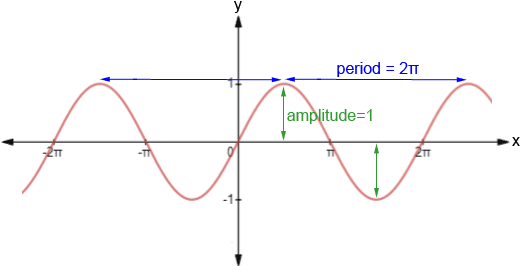
If it sounds good on a sinusoid, it will probably sound good on another type of signal.
If you modify a complex spectrum, you modify each and every one of its harmonics. It is simpler to start with just one.
Summing sinusoids can represent any periodic wave, i.e. sound
Digital signals are sequences that are indexed by n,
which is called the sample number n
The indices of the sequence can be represented like this:
..., n-2, n-1, n, n+1, n+2, ...f, of the sample number.A function is a mathematical term that defines a relationship between
two sets, in this case, a sample number n and its output
value, denoted f(n).
So, our Sequence of indices above becomes an indexed sequence of values, like this:
..., f(n-2), f(n-1), f(n), f(n+1), f(n+2), ...Given that the sinewave is an example of an audio signal, we need to find a function we can use. Luckily for us, we can make use of our trigonometry chops to use the sine function.
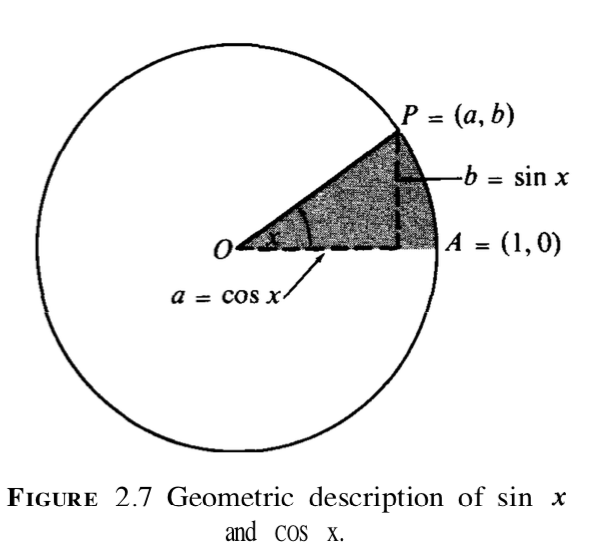
We can use the sin function in place of the
f function above and it will give us the sine wave:
..., sin(n-2), sin(n-1), sin(n), sin(n+1), sin(n+2), ...Here's a nice visual representation by Jack Schaedler
Formally, we still need a few tweaks to the sin function
above. So, the actual sinusoid needs to have all the
following parameters:
f(n) = a • sen(ωn + ø)n sample numbera amplitudeω angular frequencyø phase (we can ignore this one for
now)
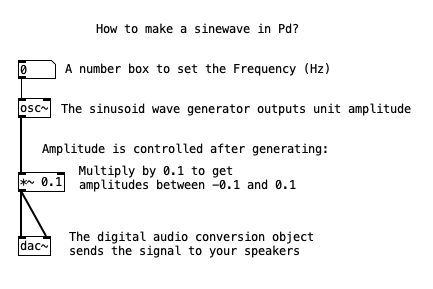
This patch is real, open it with Pd here.
Go to Using Pd for a recipe.