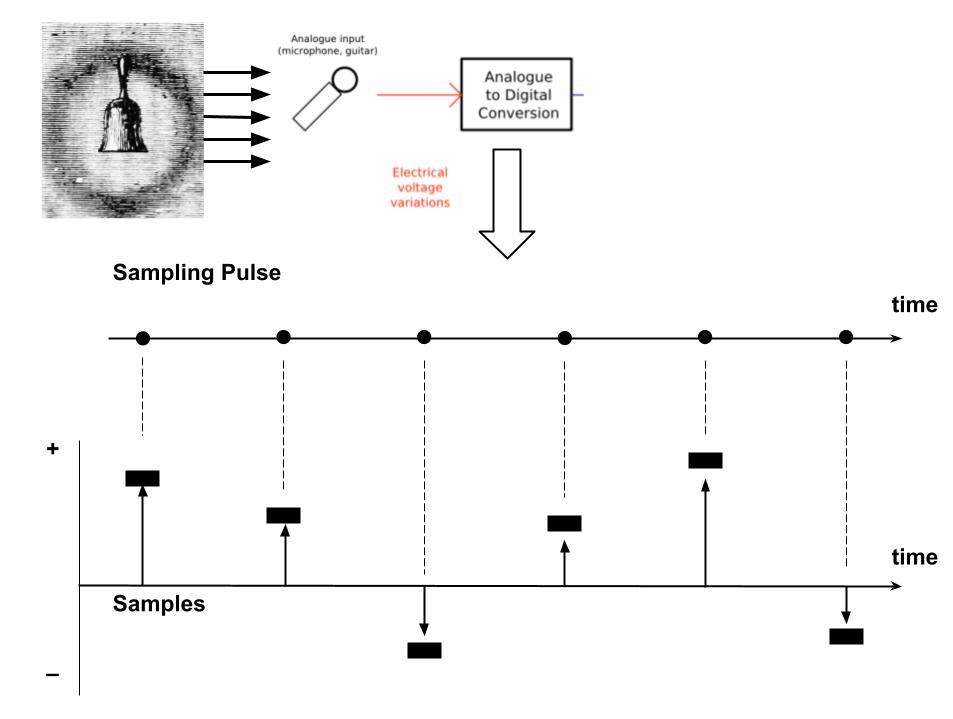
An audio sample is a single measure of Amplitude, with a certain Resolution, that corresponds to a moment in time of an electrical signal representing sound.
The diagram below summarizes this process:
To create a digital representation of the electrical signal, there must be a constant rate at which samples are taken. This is the sampling pulse above, which we generally refer to as sampling rate.
The resulting signal is composed of positive and negative integers spaced at the sampling rate. Each one of these samples holds the amplitude of the signal at that moment. This constitutes the digital audio signal.
Because of an important theorem called the Nyquist-Shannon Theorem, this signal can be (almost) fully reconstructed. This is why we say that the digital audio signal can represent sound.
For now, let's simply consider amplitude as the numerical value of each sample.
Amplitude is the base of all the digital audio field: everything relates to amplitude.
However, amplitude is neither "volume" nor "loudness", but we will see how it affects them just as much as it affects "pitch" and "timbre".
In digital audio, each sample is represented as a binary number. In binary representaiton, the size of the binary number determines the maximum number it can represent. For example, if a number has 2 bits, then the maximum number it can represent is 4, and here are other common values:
| bit depth | max number | integer range | amplitude resolution |
|---|---|---|---|
| 2 bit | 2^2 = 4 | 0 to 3, | -3 ... 3 |
| 4 bit | 2^4 = 16 | 0 to 15, | -15 ... 15 |
| 8 bit | 2^8 = 256 | 0 to 255, | -255 ... 255 |
| 16 bit | 2^16 = 65536 | 0 to 65535, | -65535 ... 65535 |
| 24 bit | 2^24 = 16777216 | 0 to 2^24-1, | -2^24-1 ... 2^24-1 |
| 32 bit | 2^32 = 4294967296 | 0 to 2^32-1, | -2^32-1 ... 2^32-1 |
As you can see, if the bit depth is low, the binary number cannot be too high. This means that there will not be a good resolution.
For a long time digital audio was recorded in 16-bit, then came 24, and finally 32 bit as computers got faster and cheaper. Here's a good explanation of 32-bit depth
In the visual world, this can be seen with lower resolution images:
| Resolution | Very Low | Low | Medium | Maximum |
|---|---|---|---|---|
| Image |  |
 |
 |
 |